A NOTE FROM MATHIAS
“I want to be honest with you before we get into any of this. I wrote this article and built this lesson, and I am also someone who has struggled with this exact pattern.
I have had mornings where I reached for my phone before my feet hit the floor. Evenings where I was physically in the room with the people I love and mentally somewhere else entirely. Moments after something went genuinely well at work where I immediately picked up the phone and undid the feeling.
I am not writing this from the other side of a solved problem. I am writing it from inside the same work, because the research is clear, the tools are real, and the self-awareness you develop through this process changes things in ways that extend far beyond the phone.
What I can tell you is that naming it is the first and most important step. You have already done that. Let that count for something.”
Mathias Ihlenfeld | Entrepreneur | Coach | Advisor
CHAPTER ONE
Why It Happens to High Performers Specifically
Most research on phone addiction focuses on teenagers and young adults. But the pattern among high-performing founders, business owners, and executive leaders is distinct, and the underlying mechanism is different enough to deserve its own framing.
The relationship a founder, business owner, or executive leader has with their phone starts as a legitimate productivity tool, and for the first few years, that framing holds. You are responsive. You are reachable. You close deals in the car, handle fires at 9pm, reply to the key account buyer within minutes because that relationship is worth protecting. The phone earns its place.
But at some point, something shifts. The business grows, the complexity multiplies, the stakeholder relationships become more demanding and more fraught. At home, life accumulates its own weight. And the phone, which was once a tool for building, quietly becomes something else: a place to go when you do not want to be where you are.
The phone does not cause the avoidance. It just makes avoidance effortless, invisible, and available every moment of the day.
This is what the neuroscience literature describes as dopamine dysregulation, the brain’s reward system, originally calibrated by years of novelty, variable feedback, and digital stimulation, now firing compulsively in response to cues rather than genuine rewards. Every check of the inbox, every scroll, every tap produces a small hit of dopamine. Over time, the baseline mood drops. The user checks the phone not to feel good, but to feel normal. The passion that used to drive the work fades. Focus degrades. Energy collapses.
Dr. Anna Lembke of Stanford, author of Dopamine Nation and one of the leading clinical researchers on behavioral addiction, notes that smartphone use in high-stress adults follows the same neurobiological pattern as substance dependency: tolerance builds, withdrawal symptoms emerge, and the behavior escalates precisely when life becomes most difficult, because the discomfort of real life drives the user toward the device.
THE CREATOR VS. CONSUMER SPLIT
One of the most useful frames for a high-performing leader is this: every moment with your phone, you are either a creator or a consumer. When you are writing, deciding, communicating with intention, solving, building, you are creating. When you are scrolling, reading feeds, checking stats that do not require action, absorbing other people’s content without purpose, you are consuming. The phone supports both. The question is which one is running your day.
Most founders, business owners, and executive leaders begin their relationship with the phone as creators. The phone serves the work. Over time, without noticing, the ratio inverts. They spend more phone time consuming than creating, and the creative identity that drove the business starts to feel distant. The energy that used to come from building goes toward scrolling. The passion fades not because the work changed but because the mode changed.
This frame is worth keeping close. When you reach for your phone, ask one question before you unlock it: am I about to create something or consume something? That pause, held honestly, will tell you more about your phone habit in a week than any screen time report.
WHEN HOME IS NOT A SAFE HARBOR
Research consistently shows that anxiety, interpersonal conflict, and chronic stress are the most powerful accelerants of compulsive phone use. A peer-reviewed meta-analysis published in 2022 found that difficulties in emotion regulation are strongly and bidirectionally linked to problematic smartphone use, meaning that stress drives phone use, and phone use erodes the capacity to regulate stress, which drives more phone use.
For the leader whose home is a source of stress rather than rest, this dynamic is particularly acute. It is not the abstract stress of a bad quarter. It is the specific, embodied stress of not knowing what version of the evening is waiting on the other side of the front door. The nervous system reads this uncertainty as threat and stays in a low-grade activation state for hours before the door even opens. The phone is already in the hand before the key is in the lock.
Many leaders in this situation are also managing investors, board members, or key stakeholders whose dynamics generate their own specific dread. There is a particular kind of avoidance that deserves to be named: the email you know you should write to a difficult person but keep not writing, while checking your phone constantly in the meantime. The phone is simultaneously the tool you need to have that communication and the thing you are using to avoid preparing for it. You pick it up, see the name, put it down, scroll something else, repeat. This loop can consume hours while producing the feeling of having been busy the entire time.
The clinical term for all of this is experiential avoidance. Avoidance does not eliminate the discomfort. It deepens it, while simultaneously degrading the cognitive and emotional capacity needed to address the underlying source.
BEING IN THE ROOM WHILE BEING SOMEWHERE ELSE
There is a specific behavior that carries more long-term cost than almost any other form of compulsive phone use, and it is the one most people feel the most shame about: being physically present with people who matter to you while being mentally and emotionally somewhere else entirely.
This is not the same as checking a message during dinner. It is the sustained, low-grade absence that happens when the phone is in the hand or on the table or nearby enough to pull half your attention into a state of monitoring while the other half is nominally in the conversation. The people across from you register it. Children especially register it, even when they do not name it. Research on partner phubbing shows that the damage to relationship quality occurs whether or not the phone is actively being used, because the mere availability of the device signals that the present moment is not enough on its own.
For a leader whose most important relationships are already strained, this behavior is not neutral. It is active. Every evening spent in the same room but on separate screens is a small withdrawal from an account that is already running low.
The corrective is not complicated but it is non-negotiable: the phone is not in the room. Not face-down. Not silenced. Not nearby. The people you come home to deserve the same quality of attention you bring to your best meetings.
CHAPTER TWO
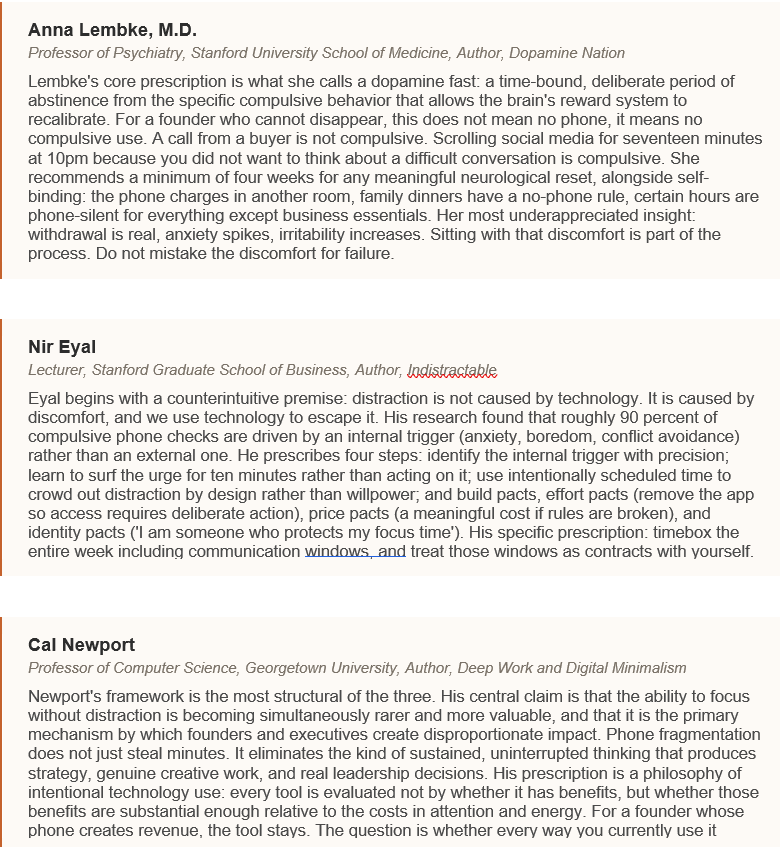
What Three World-Class Experts Would Tell You
The following perspectives are drawn from three of the most cited researchers and practitioners in this space. Their frameworks are each addressed to someone who cannot simply go off the grid, someone who runs a company and needs their phone to function.
WHAT ALL THREE AGREE ON
The goal is not less phone. The goal is a phone that is a tool again, not a reflex. The measure of success is not screen time reduction. It is whether you are present in the moments that matter most.
CHAPTER THREE
The Prescriptive Approach for a Working Leader
The following protocol is built for a founder, business owner, or executive leader who runs a company, has investors and a team and key accounts who need to reach them, and has decided they are done letting their phone run their day. It is not a detox. It is a structural rebuild.
There are two non-negotiables before anything else: be honest about what you are using your phone to escape from, and understand that the protocol will not work if the underlying discomfort is not also being addressed directly. The phone is the symptom. Treat the symptom and the source simultaneously.
01 Conduct a 10-day trigger audit before changing anything
Carry a small notebook. Every time you reach for your phone outside a clear, intentional use, pause and write one sentence: what were you feeling in the 60 seconds before you picked it up? Do this for ten days without changing any behavior. What you will find is a map of your avoidance patterns, which conversations you were dreading, which decisions you were not ready to make, which silences you could not sit in. This is more valuable than any app timer.
02 Protect the morning before the phone enters the day
The first 60 to 90 minutes of the morning belong entirely to you. If you have already built a morning practice, exercise, sauna, cold plunge, journaling, meditation, protect it with the same ferocity you would a board meeting. The phone does not enter until this block is done. Every day this is protected is a day that starts on your terms.
03 Define your business-critical uses and protect only those
Sit down and be specific: what on your phone is genuinely required for the business? Calls from buyers, texts from the ops team, investor messages, list them. Now list everything else. Social media, news apps, ambient browsing, these are not business tools. Delete the optional apps from your phone. Keep the business tools. The trigger audit from step one will clarify the line.
04 Create scheduled communication windows and communicate them
Being available at every moment is not a professional virtue, it is a boundary failure that costs you cognitive capacity. Set two or three windows per day for messages and non-urgent calls: morning (after your protected time), midday, and end of day. Tell your team. Most things are not as urgent as the anxiety around them suggests.
05 Protect one 90-minute deep-work block daily, phone in another room
Research at UT Austin showed that the mere presence of your smartphone on the desk, powered off, face-down, measurably reduces available cognitive capacity. The only solution is physical separation. One 90-minute block per day of phone-free, single-task focus. This is where strategy happens. Protect it like a board meeting.
06 Make the phone physically inconvenient for compulsive use
Remove social and news apps, access them on a desktop only. Use grayscale mode to strip the visual reward from the screen. Turn off all non-essential notifications. The goal is not restriction, it is adding enough friction that compulsive use becomes a conscious choice rather than an automatic one.
07 Use exercise as a neurological intervention, not just a health habit
Exercise is one of the most effective hormetic stressors, behaviors that involve short-term discomfort in exchange for durable elevation of baseline dopamine. 20 to 30 minutes of moderate-to-high intensity activity, particularly in the morning, measurably improves executive function, emotional regulation, and distress tolerance. Stack it with your morning routine.
08 Build phone-free presence into the relationships that matter most
Research on partner phubbing shows consistent negative effects on relationship quality, emotional intimacy, and perceived investment, amplified in relationships already under strain. For a leader whose most important home relationships are demanding more presence, bringing the phone to the dinner table communicates, at a neurological level, that the screen is more important than the person.
CHAPTER FOUR
Beyond Willpower: Unconventional Tools That Actually Work
For founders, business owners, and executive leaders who have tried the standard approach and kept sliding back, the following tools are worth knowing about. Some are physical. Some are social. Some are structural in ways that willpower simply cannot replicate. None of them require perfection, they require a decision made in advance, before the urge arrives.
The most effective strategies do not rely on resisting the impulse. They make acting on the impulse structurally difficult before the impulse ever shows up.
BRICK: THE PHYSICAL KILL SWITCH (GETBRICK.COM)
Of all the physical tools currently available for managing compulsive phone use, Brick is the one most precisely designed for someone who needs their phone to remain functional as a business tool while making distraction structurally impossible.
Brick is a small NFC-powered device, roughly the size of a thick business card, that works alongside a companion app on both iOS and Android. You open the app, select a mode you have pre-configured, Work, Family Time, Wind Down, Morning Routine, and tap your phone against the Brick. Every app or website you have designated as a distraction is immediately blocked, along with its notifications. To unblock them, you have to physically return to the Brick device and tap again.
That last part is the entire design. Brick works differently from digital screen time tools because you cannot undo it from the couch. You need the device. You have to get up. Most compulsive phone use happens in zero-resistance moments. Remove the easy path and most of it simply does not occur.
What makes Brick specifically suited to a working leader is the custom modes system. A work mode blocks social media while leaving calls, texts, email, and business tools fully accessible. A family mode blocks everything except emergency contact capability. A wind-down mode eliminates social feeds and news while leaving music and reading apps open. The phone remains a functional business tool in every mode. What disappears is everything you use it to escape.
Brick also includes Strict Mode, preventing the app from being deleted or settings changed to bypass the block. Unlike native Screen Time limits where tapping ‘Ignore Limit’ returns full access in seconds, Strict Mode means the only path back is the physical device.
Place the Brick somewhere intentionally inconvenient. Not on your desk. Not next to your couch. On the kitchen counter downstairs, by the front door, or in another room you have to walk to deliberately. The physical distance is the intervention. One-time purchase, no subscription. Available at getbrick.com.
OTHER PHYSICAL LOCKBOXES
The Kitchen Safe (kSafe) is a time-locked container, you place your phone inside, set a timer for anywhere from one minute to ten days, press the button, and it locks. No override. No code. You wait. Studies from Princeton, Harvard, Stanford, and Yale support precommitment devices as among the most effective behavioral interventions available. You make the decision once, in advance, and the device enforces it.
The Mindsight lockbox adds a Fortress mode, a setting that provides no code override whatsoever. You cannot open it until the timer reaches zero. The Yondr Home Tray goes further: it is signal-blocking, using faraday fabric to block 5G, Wi-Fi, cellular signal, Bluetooth, GPS, and RFID entirely when closed, originally developed for concerts and schools, now available for home use.
THE DUAL PHONE STRATEGY
One of the most structurally elegant solutions for a leader who genuinely needs a smartphone for business is two phones: one for work, one for everything else, and making the ‘everything else’ phone as simple as possible. The business smartphone stays business-only. In the evenings and on weekends, it docks. The second device handles anything personal, with no apps, no browser, no social feeds.
THE ACCOUNTABILITY PARTNER
The research on behavioral change is consistent: public commitment and social accountability are among the most durable behavior change mechanisms available. Telling someone what you intend to do, and knowing they will ask about it, activates a completely different part of the brain than private resolve.
The specific structure matters. Vague accountability (’I’m going to use my phone less’) produces vague results. Specific accountability (’I will complete the 10-day trigger audit and share my findings by Friday, and I will not check my phone before 7:30am on any weekday’) produces measurable ones. The most effective accountability partner is someone who has skin in the same game, a fellow founder, a peer in a mastermind, or a coach who is already doing this work with you and can hold you to the standard you set for yourself.
For the highest-stakes version: a commitment contract with financial stakes. Sites like Beeminder allow you to attach a real financial penalty to your stated commitment. Loss aversion means the pain of losing something is roughly twice as motivating as the pleasure of gaining something equivalent. A well-structured commitment contract is not a punishment. It is a precommitment device that changes the calculus before the craving arrives.
DESIGNED DEAD ZONES
Instead of managing your relationship with your phone everywhere, designate specific physical spaces where the phone simply does not exist. The rule is categorical and requires no decision in the moment. The dinner table: phone in another room, not face-down. The bedroom: a dedicated charging station in the kitchen or hallway, paired with a basic alarm clock. The car on the drive home: use the commute to decompress, not to process. The sauna or gym: let the body reset without the screen.
SCREEN TIME TRANSPARENCY, SHARE YOUR DATA
Most people who check their screen time data feel a brief flicker of discomfort and then close the app. The more powerful version is to share that data with someone else. The specific metric to watch is not total screen time, it is the number of pickups and when they cluster. A leader who checks their phone 80 times between 8pm and 10pm is not managing a business. They are managing anxiety. That data, seen clearly and shared honestly, is often the single most galvanizing moment in this entire process.
CHAPTER FIVE
The Good Day Problem: Why Success Triggers the Phone
There is a pattern that almost no one talks about, but that shows up consistently in high-performing founders, business owners, and executive leaders who are genuinely doing the work: they have a strong morning. A clean focus block. A productive meeting. A week where the numbers moved. And then, almost reflexively, they pick up the phone and undo it.
They call it self-sabotage. And they are right. But naming it does not explain it. And without understanding why it happens, there is no way to stop it.
The phone is not just what you reach for when things go badly. For many high-performers, it is what they reach for when things go well. That is the part no one prepares you for.
WHY SUCCESS TRIGGERS AVOIDANCE
Success raises the stakes of future failure. When a day goes well, the implicit question underneath the surface is: can I do that again? For someone carrying a long history of being labeled an underachiever, or who has built something significant against the odds, a genuinely good day quietly activates a fear that the gap between expectation and reality is now wider. The phone collapses that gap immediately. It is almost impossible to feel like a high-performer while doom-scrolling. It flattens the pressure of having to be one.
Success without celebration creates an emotional vacuum. Most leaders are terrible at completing the loop on wins. They move from one problem to the next without pausing to acknowledge what just happened. The nervous system, unacknowledged, stays activated. The phone fills that gap. It provides low-stakes stimulation that mimics rest without delivering it.
Progress produces guilt. A strong day at work, in a context where the home situation is not strong, can produce a quiet guilt that is hard to name but easy to feel. The good day at the office feels like an indictment of the situation at home. The phone is the fastest available escape from that particular discomfort. It does not resolve the guilt. It postpones it, and adds a layer of self-contempt on top.
The nervous system does not know how to accept ease. Leaders who have spent years operating in chronic low-grade stress become neurologically calibrated to that stress level. When the day goes well and the threat signals quiet down, the system experiences the calm as wrongness. Something must be wrong, because nothing feels urgent. The phone restores the urgency, delivering a small hit of anxiety that feels, paradoxically, more familiar than the peace it disrupts.
THE IDENTITY THREAT OF A GOOD DAY
Many high-performing founders, business owners, and executive leaders carry an unresolved internal narrative about who they are. Often it was installed early, a label from a teacher, a parent, a school system, or a family dynamic that decided what kind of person you were before you had enough evidence to argue back. Not the disciplined one. Not the smart one. Not the one who finishes things. The business, the role, the revenue, the team: these are all evidence against that old story. But evidence alone does not rewrite the story. The old identity persists underneath the achievement, and a genuinely good day threatens it.
Because if you are actually capable of this, if you can actually focus and produce and lead at this level, then the old story about yourself is wrong. And that raises a question the mind would rather not face: what else have you been wrong about? What years of smaller living were based on a belief that was never true?
For leaders whose sense of worth has also been entangled with the expectations of investors, family members, or others with conditional stakes in their success, a good day carries an additional weight. Success in this context does not feel clean. It feels provisional. Like something that could be taken away, or that you are not quite allowed to inhabit fully yet. The phone is the great equalizer. It is impossible to feel like you have arrived while you are scrolling. And that, unconsciously, is exactly the point.
WHAT THIS LOOKS LIKE IN PRACTICE
A clear, focused morning followed by 45 minutes of scrolling before lunch. A productive week capped by a Friday evening where the phone does not leave the hand. A meaningful conversation that ends with 20 minutes of news consumption that leaves you feeling worse than before. The pattern is rarely random. It almost always follows a moment of genuine competence or genuine connection.
BREAKING THE SABOTAGE LOOP
Name it in real time. Notice it as it happens, in the moment when the impulse arrives after something went well. The question to ask is not ‘why am I picking up my phone?’ It is ‘what just happened that I am not letting myself have?’ That reframe changes the nature of the impulse entirely.
Close the loop on wins deliberately. Build a specific, brief ritual that marks the end of a good piece of work. Write one sentence in your journal. Text your accountability partner. Stand up, walk outside for five minutes, and do nothing. The ritual does not need to be elaborate. It needs to be real.
Treat the post-success window as high-risk time. Once you see the pattern clearly, that phone use spikes not just in moments of stress but also in the hour after something goes well, you can treat that window with a plan, not with willpower. Put the phone in the box. Have the next activity already scheduled.
Separate the phone from the reward. Replace the phone with a different reward after a win: a walk, a call to someone you enjoy, ten minutes with a book. The dopamine system does not care what the reward is. It cares that one exists and follows the behavior. You are retraining a circuit, not fighting your own character.
Address the identity story directly. This is coaching and therapy work, not phone work. But it is the most important piece. The question worth bringing into your coaching sessions, your journaling, and your honest self-examination: what do you believe would happen if you simply let the good day be enough?
The phone is the answer to that question. It is what you have taught yourself to do when the answer feels too uncomfortable to stay with. The work is not to take the phone away. The work is to make the question safe enough to sit inside of for longer than the impulse lasts.
CHAPTER SIX
A Sample Daily Structure
The following is not a rigid template. It is a skeleton showing how the protocol translates into a real day for a leader who has morning practices already in place and a business that requires genuine availability.
WHAT I COMMIT TO
5:30 – 7:30 AM Protected morning, phone off or in another room
If you have already built a morning practice, exercise, sauna, cold plunge, journaling, meditation, protect it. The phone does not enter until this block is complete. Every day this holds is a day that starts on your terms.
7:30 – 8:00 AM First communication window
Scan messages, respond to anything time-sensitive from the team. Delete or defer anything that does not require your attention today. Close and put the phone away.
8:00 – 9:30 AM Deep-work block, phone in another room
Your single most important cognitive task of the day. Strategy, decisions, writing, high-stakes analysis. The phone is not in the room. This is the block where you earn your role as leader.
9:30 AM – 12:30 PM Open business hours, phone as a tool
Calls, meetings, buyer conversations, team interactions. Phone available for intentional business use only. Note when you reach for it outside a specific purpose.
12:30 – 1:00 PM Midday communication window
Second scan and response block. Decide what requires your time today versus what can wait or be delegated.
1:00 – 5:00 PM Afternoon work, phone as a tool
Meetings, calls, execution work. When you catch yourself reaching from discomfort rather than purpose, pause for ten minutes before acting.
5:00 – 5:30 PM End-of-day communication close
Final message scan. Reply to anything genuinely needed. Set a clear end. Tell your team when you are offline. This boundary is a model for your team, not a dereliction of duty.
5:30 PM onward The front door is the line
Before you walk in, the phone goes into a mode that blocks everything except calls and texts. Tap the Brick, activate family mode, or dock it in the kitchen within 60 seconds of arriving. The people inside deserve to meet you, not the version of you that is still somewhere else.
CLOSING
The Real Thing This Is About
Every founder, business owner, and executive leader who works honestly through this protocol arrives at the same place: the phone was never the problem. It was the most visible symptom of an energy equation that had gone deeply out of balance. Too much given out. Not enough protected. And a growing reliance on an easily available escape from the feelings that came with that imbalance.
This protocol will reduce screen time. It will improve focus, sleep, and cognitive performance. It will make you more present in the relationships that matter most. But it will only hold if the underlying work is happening simultaneously, addressing the sources of the discomfort, not just blocking the escape route. The behavioral changes are the surface. The identity work, the relationship work, the honest reckoning with what you have been using the phone to avoid, that is where the real change lives.
If you have already built a morning practice, that is not nothing. That is the foundation. If you journal, if you have started to understand your own energy and the relationships that drain it, if you have begun to name what you have been avoiding, you are further along than most people who read something like this. The phone protocol is not a separate project from that work. It is the next logical layer of it.
The version of you that built something from nothing did not need a phone to feel okay. You still do not. That person is not gone. He is just buried under a habit that got normalized so gradually you stopped noticing it was a choice.
You built something real. You are capable of focus, leadership, and presence at a level most people never reach. The phone is not taking that from you. You are lending it away, in small increments, to a device that gives nothing back. Stop lending. Structure the day around your practices. Let the phone serve the business. And let everything else belong to the life that makes the business worth building.
That is the prescription. Not less phone. More of you.
ENERGY FOUNDATIONS PROGRAM
“The protocol is only as strong as the support around it. The work accelerates significantly when you are not doing it alone.”
This guide is one part of the Energy Foundations Program, a coaching-supported framework for founders, business owners, and executive leaders who are ready to protect their energy, rebuild their focus, and lead from a position of genuine capacity rather than constant depletion.
If you are working through this material and want to go deeper, the next step is a direct conversation. I work with a small number of founders and executives on exactly this. If that's you, let's talk.
mathias@mathiastx.com
Mathias Ihlenfeld | Entrepreneur | Coach | Advisor | May 2026
About Me
Mathias Ihlenfeld is a proud father of Luca (13) and Sofia (11), loving partner to Doralicia, and an award-winning entrepreneur based in Austin, TX.
He serves as the Austin Cohort Leader and Coach for the Birthing of Giants Regional Cohort, a selective fellowship program for growth-focused founders and CEOs building high-impact companies.
He is also the creator of The R.E.C.L.A.I.M. Code, an elite personal optimization framework built specifically for divorced high performers. His proprietary 6-stage framework helps divorced founders rebuild identity, attract aligned love, and ignite purpose-driven business performance.
As the founder of woom bikes USA, Mathias built one of North America’s fastest-growing direct-to-consumer kids’ bike companies, earning multiple Inc. 5000 honors—including a 742% three-year growth rate in 2020—and recognition as one of the fastest-growing private companies in the U.S. In 2021, he played a pivotal role in merging the U.S. and European operations, leading the combined $100M global business as CEO in 2022 and 2023. His leadership has been recognized with honors such as Ernst & Young Entrepreneur of the Year finalist and the Vistage Impact Leadership Award.
A graduate of the Birthing of Giants Fellowship Program, Mathias brings decades of expertise in entrepreneurship, business transformation, and conscious leadership. Through his coaching practice, he works with founders, executives, and high-achieving men navigating personal reinvention, guiding them through identity rebuilding, emotional mastery, business growth, and relationship alignment.
Today, Mathias mentors with SKU, invests in purpose-driven brands, and writes on his Substack—sharing hard-earned lessons, strategic insight, and stories from his journey building global brands and leading life transformations.